



When to Clean Gutters in Fall: Your Trees Set the Date, Not the Calendar
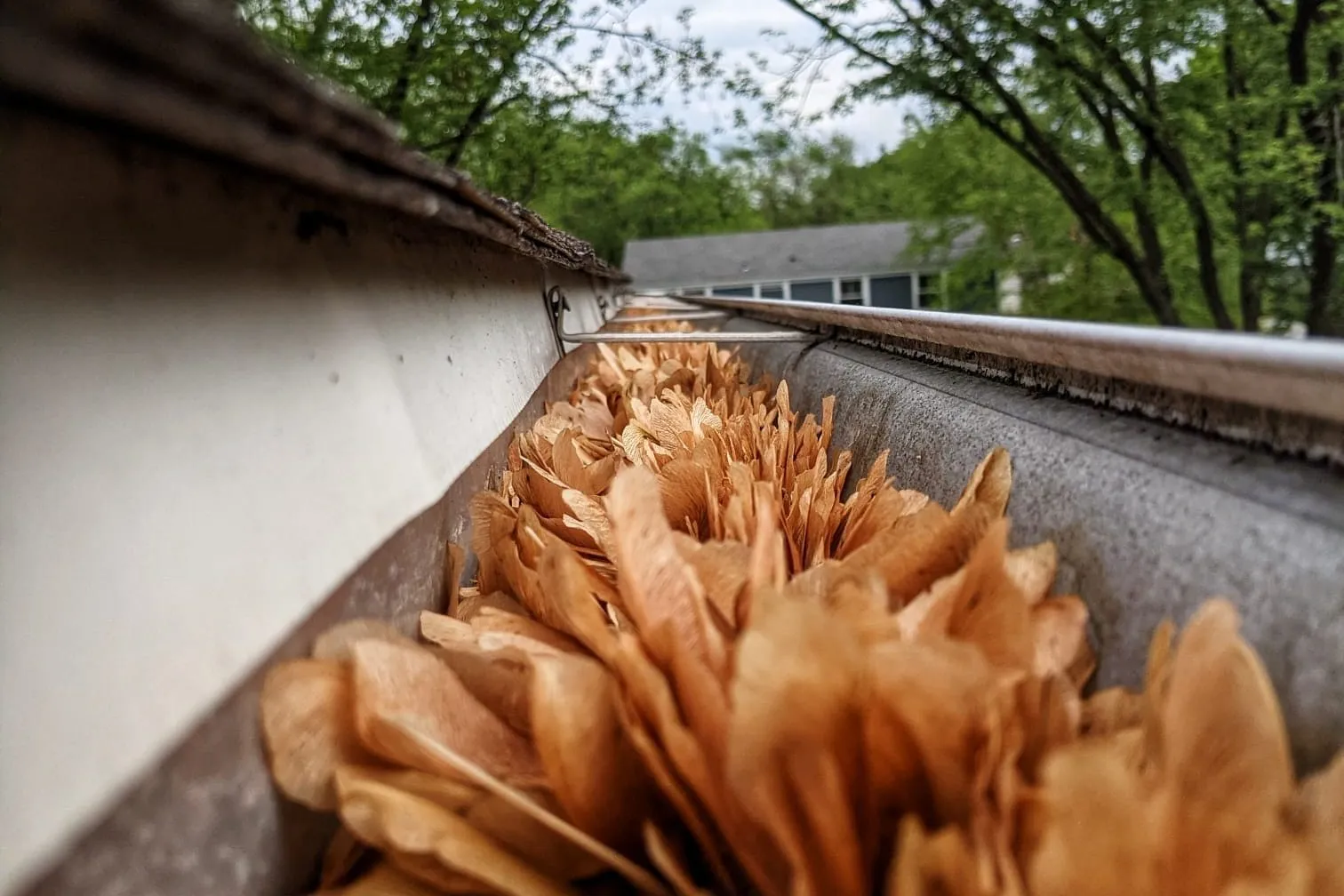
Here is the complaint we hear every December, almost word for word: “I had the gutters cleaned in October and they are packed again.” The homeowner did the responsible thing, on the schedule everyone recommends, and still ended up with water sheeting over the front of the house in the first freeze. It is not a bad cleaning. It is a bad date — and the date was wrong because it came off a calendar instead of off the trees standing over the roof. Get that one thing right and most fall gutter problems disappear.
“Twice a Year” Is a Schedule, Not an Answer
Search when to clean gutters and you will get the same sentence everywhere: twice a year, once in spring and once in fall. It is not wrong exactly. It is just a habit dressed up as a rule, and it leaves out the only variable that actually decides anything — what is growing above your roof.
Gutters do not fill on a date. They fill when specific trees let go, and different trees let go weeks or even months apart. Two houses on the same block can need completely different schedules: the one on the open corner lot genuinely needs one visit a year, and the one under a pair of mature pin oaks needs three and will still have debris in the downspouts.
So the useful question is not “when in the fall.” It is: what is over my roof, and when does the last of it finish dropping? Everything below is how to answer that for your own house.
Trees Drop in Three Waves, Not One
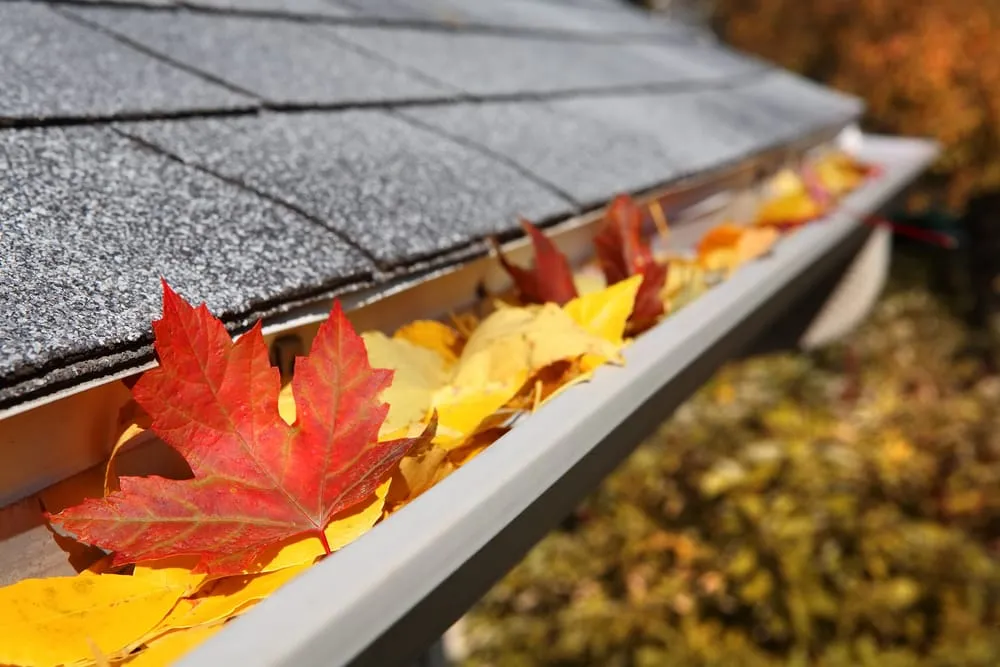
Autumn looks like a single event from the driveway. It is not. In the Chicago region, leaf fall is spread across roughly three months, and it arrives in three distinct waves. Knowing which wave is over your house is the whole trick.
| Wave | Common trees | When they finish | What it means for gutters |
|---|---|---|---|
| 1. Early | Ash, black walnut, birch, honey locust, catalpa, horse chestnut | Mid-Sept – mid-Oct | Fills gutters before most people think about it |
| 2. Main | Maple, elm, linden, hackberry, ginkgo | Mid-Oct – early Nov | The wave everyone pictures; sets the classic date |
| 3. Late | Oak, beech, hornbeam; pine and spruce needles | Nov into winter — sometimes March | Breaks the one-visit schedule completely |
Wave one catches people out because it happens while the weather is still pleasant and nobody is thinking about gutters. Drought years make it earlier still — The Morton Arboretum notes that drought-sensitive species including walnut, honey locust and some birches can show fall color early when the region is dry.
Wave two is what the phrase “fall cleanup” was built around. The Arboretum's guidance for the Chicago region puts most trees at peak color in mid-to-late October, and the bulk of the leaves are on the ground within two or three weeks after that. If everything near your roof is in this wave, a single well-timed cleaning genuinely does the job.
Wave three is the one that ruins schedules, and it deserves its own section.
The Oak Problem: Why Clean Gutters Clog Again in December
Most oaks do not drop their leaves in the fall at all. They hold them — brown, dead, and still firmly attached — through the winter, releasing them a handful at a time on every windy day from November until the new buds push them off in spring.
The botanical term is marcescence, and University of Illinois Extension explains the mechanism plainly in its piece on the stubborn beauty of oak leaves. Normally a tree forms a layer of specialized cells at the base of each leaf, cutting off water and nutrients so the leaf drops cleanly. In marcescent species “this abscission layer is delayed or only partially forms.” Extension names the usual suspects directly: “Oak species (Quercus sp.) and beech trees (Fagus sp.) are commonly observed exhibiting this characteristic.”
Now here is the detail that matters to your gutters, and almost nobody connects it. Extension adds that “marcescence tends to be more prominent in juvenile trees or on lower branches of mature trees.” Read that again with a roof in mind. The lower branches are the ones hanging over your house. The exact part of the oak that holds its leaves the longest is the part positioned directly above your gutters. The high canopy may look bare from the street while the branches over your roofline are still loaded.
Three things follow from this:
- There is no single drop date to schedule around. An oak releases in dribs across two to four months, so there is no morning where you can say “that is the last of it.”
- Oak leaves are the worst kind of debris. They are thick, leathery, and high in tannins, so they break down slowly and mat into a dense mass that holds water rather than letting it drain through.
- Oaks make a mess twice. Spring brings catkins — the stringy tassels that shed by the thousands and pack downspouts as effectively as leaves do.
Put those together and a mid-October gutter cleaning under an oak is not a fall cleaning. It is a cleaning performed at roughly the halfway point of the debris season, which is exactly why the gutters are full again by the time the first hard freeze arrives.

The Two Questions That Set Your Schedule
You do not need to identify every tree on your property. You need to answer two questions.
Question one: what is growing within about 40 feet of the roofline? Not just what overhangs it — wind moves leaves a surprising distance, and a neighbor's silver maple two lots upwind will deposit more in your gutters than the ornamental pear in your own front yard. Walk the perimeter and look at everything tall enough to reach the roof, in every direction.
Question two: which wave does the latest of them belong to? Not the average — the latest. One oak sets the schedule for the whole house, the same way one late guest sets the end of a dinner party.
From there the rule is short enough to remember:
- Everything is wave 1 or 2 → one visit. Book it for about two weeks after the last tree goes bare. In Chicagoland that usually lands in the first half of November.
- Anything in wave 3 → two visits. The first in late October or early November to clear the main wave, the second once the oaks have largely let go — often late in the season, sometimes not until early spring.
- Pines or spruces close by → three visits, minimum. Needles shed year-round with a heavy autumn push, and they are worse than leaves in one specific way: they are small enough to slip through most guard systems and fine enough to weave into a mat that plugs a downspout completely.
- Nothing within 40 feet → one visit is genuinely enough, and spring is probably the better time for it, since you will be clearing winter grit and roof granules rather than leaves.
And one field test that beats any date, worth doing before you pick up the phone. Stand at your downspout and look straight up. If the branches above you are more than about 90 percent bare, a cleaning done now will hold. If they are 60 percent bare, you are paying to do the job twice. That single glance is more accurate than any calendar, because it measures the thing that actually matters.
What Getting the Timing Wrong Actually Costs
It helps to see the volume of water involved, because gutters look like trim and behave like plumbing. The arithmetic is simple and worth doing once. One inch of rain on one square foot is 144 cubic inches of water, and a US gallon is 231 cubic inches — so every square foot of roof yields about 0.623 gallons per inch of rain. A modest 1,000 square foot roof therefore sheds roughly 623 gallons in a single inch. A 2,000 square foot footprint sheds around 1,250 gallons.
Now add the season. The National Weather Service office serving Chicago publishes November normals of 2.42 inches of precipitation and 1.8 inches of snowfall on the 1991–2020 record. A typical Chicago November therefore pushes something like 3,000 gallons through the gutters of an average suburban house — after the leaves are down, and while the thermometer crosses freezing over and over.
That is the whole problem in one sentence. The water arrives at exactly the moment the gutters are most likely to be blocked, and it arrives at a temperature where it does not stay water.
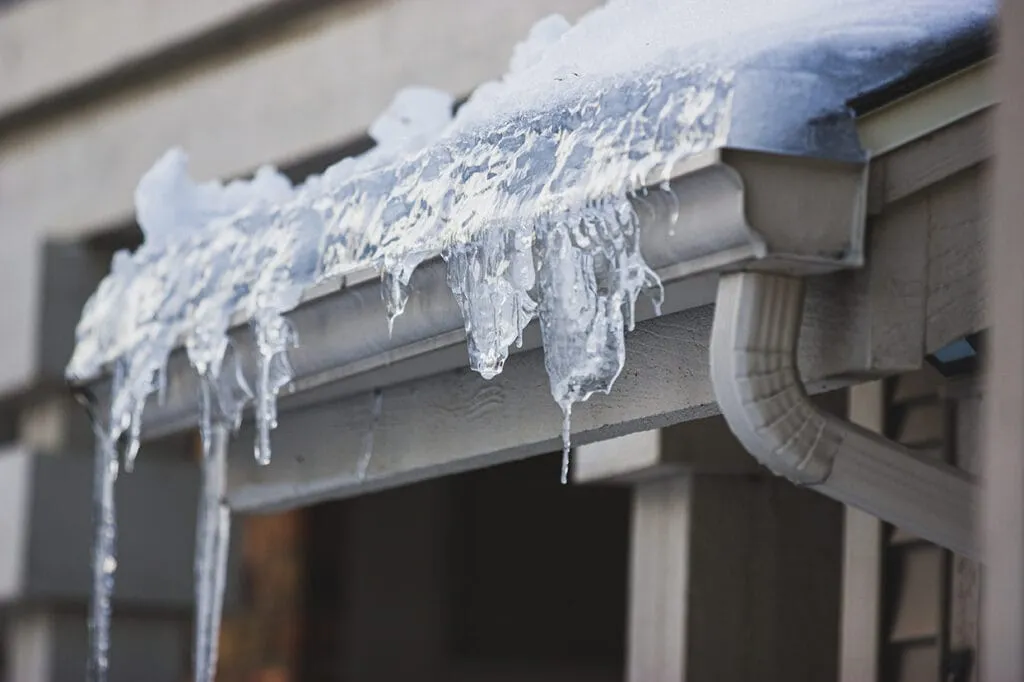
The freeze-in is the part homeowners underestimate. A gutter packed with wet leaves in mid-November is a routine cleaning. The same gutter after a hard freeze is a solid plug of ice and organic matter bonded to the aluminum, and it is no longer a cleaning job at all — you cannot chip ice out of a gutter without denting or unseating it, so the work waits for a real thaw. In this climate that wait can run into January. Meanwhile the meltwater coming off the roof has nowhere to drain, which is the standard setup for ice dams: water backs up behind the ice at the roof edge, works under the shingles, and shows up as a stain on a bedroom ceiling. Our guide to what drives ice dam removal cost covers where that goes from there, and the short version is that it is a multiple of what a second gutter visit would have cost.
There is a load problem too. A 30-foot run of gutter packed with soaked debris and then frozen is carrying serious weight, and all of it hangs from fasteners driven into fascia board — wood that has been kept damp all autumn by the same blockage.
When One Visit Is Genuinely Enough
We would rather say this plainly than sell a second visit to someone who does not need one. A single fall cleaning is the right call if:
- Your lot is open. Nothing tall within about 40 feet in any direction, including the neighbors' trees and the prevailing-wind side.
- Everything near the roof is wave 1 or 2 and you can book after it is all bare, rather than in the middle of the drop.
- Your landscaping is young. New construction with newly planted trees produces very little roof debris for the first several years.
- You have guards and no oaks or conifers. Guards handle broad leaves well. As our gutter guards page puts it without hedging, guards reduce maintenance, they do not eliminate it — fine grit, shingle granules, pollen, and especially pine needles still get through. But paired with the right trees, guards can move a two-visit house down to one.
If two or three of those describe your house, book once, book it right, and spend the money on something else.
From Our Side: What Eighteen Autumns in Chicagoland Look Like
Our gutter cleaning page has recommended cleaning and inspection at least twice a year for as long as we have had the page up. This article is the reasoning behind that line. It is not an upsell script — it is what an oak-heavy region does to a one-visit schedule, seen from the top of a ladder since 2008.
A few things we have learned that shape how we work the fall season:
The downspout is the job. Anyone can pull leaves out of a trough. On a late-season visit the failure point is almost always further down: a clear gutter feeding a packed downspout is not a working gutter, it is a bathtub. So our process does not end when the trough is empty — we inspect and unclog the downspouts as a separate step, and we install downspout caps at $15 each including labor and materials when they are missing.
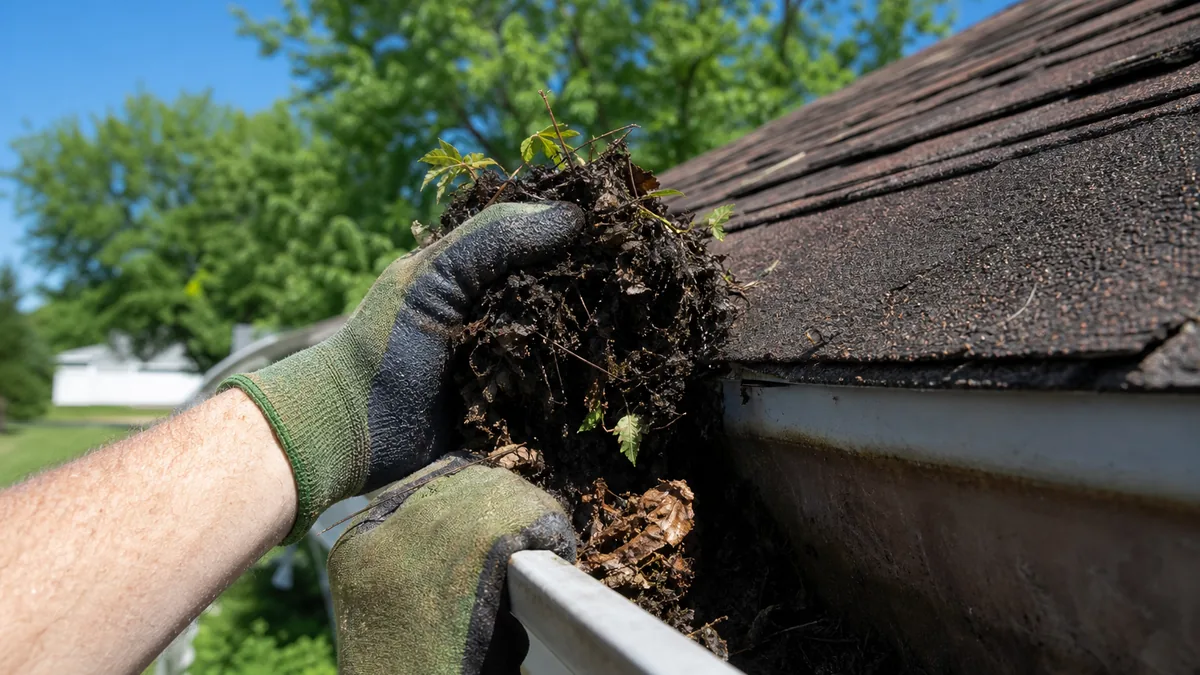
Debris leaves with us. We pull everything out by hand or with a blower, bag it, and take the bags. A pile of wet oak leaves raked off the roof and left in the beds is half a job.
We tell you what we found. If the fascia is soft, a hanger has pulled loose, or a seam is separating, you hear about it while we are still there rather than in January. And if the trees over your roof mean you will want a second visit, we say so at the first one — along with roughly when.
Our pricing is published rather than quoted on the doorstep, which we think is the honest way to do it:
| House size (sq ft) | 1 Story | 2 Story | 3 Story |
|---|---|---|---|
| up to 2,000 | $120 | $150 | $200 |
| 2,001 – 3,000 | $130 | $170 | $225 |
| 3,001 – 4,000 | $150 | $200 | $250 |
| 4,001 – 5,000 | $200 | $225 | $300 |
| 5,001 – 6,000 | $200 | $250 | $350 |
| With guards | add $30 | add $50 | add $80 |
That last row is worth explaining rather than burying, because it surprises people who were told guards end maintenance. Cleaning a guarded gutter takes longer, not less time: the debris has to be cleared from on top of the guards and from underneath them, which usually means lifting or unfastening sections and putting them back properly. We do not install guards, so we have no stake in whether you have them — we just charge for the extra work honestly. If you want to see what a full year of visits adds up to, our guide to gutter cleaning cost in Chicago works through four typical houses, oak-shaded lot included.
Set that against the alternative. A second gutter visit on a typical two-story home is $150. An ice dam that has already put water through a ceiling is a different order of number entirely, and it arrives in January when everyone in the region is calling at once.
For context on the rest of it: we are family-owned, based in Buffalo Grove, and we cover all six Chicagoland counties — Cook, DuPage, Lake, Will, McHenry and Kane. We are licensed, insured and bonded, every job carries our 7-day satisfaction guarantee (tell us within 7 days and we re-clean at no charge, or refund you if you are still not satisfied), and we hold a 4.9-star average across 365 Google reviews plus three separate years as a Nextdoor Neighborhood Favorite. You can read those customer reviews yourself, see the work in our project gallery, or read how we actually run a job from the first phone call to the final walk-through.
One scheduling note worth knowing: the weeks that close out gutter season are the same weeks that close out exterior window washing, and the order matters. Overflowing gutters sheet dirty water down the glass and siding all autumn, so clean gutters first and the windows you just paid for stay clean. Our post on how late you can wash windows in Chicago covers that end of the sequence.
A Chicagoland Timing Calendar
Regional averages are a starting point, not a booking date. Use this as the frame and then apply the bare-branch test to your own roof.
- Mid-September to early October. Wave one finishes. If ash, walnut or honey locust dominate your lot, this is your first visit. For everyone else it is the time to get on a schedule — this is when the phones start and the good slots go.
- Mid-to-late October. Peak color across the region, per The Morton Arboretum's weekly fall color report, which is genuinely useful for tracking what has turned. Peak color means the leaves are still on the trees. Cleaning under maples right now is premature.
- Around October 19. The normal first freeze at O'Hare on the 1991–2020 record. Not a gutter deadline, but the start of the freeze-thaw cycling that turns wet debris into something you cannot remove.
- Early to mid November. The best single window for the main fall cleaning in Chicagoland. Wave two is down, the ground is still workable, and you are ahead of the weather.
- Late November into December. Oak-country second visit, and the last comfortable chance before a packed gutter becomes a frozen one.
- January and February. Too late for cleaning. This is ice dam season, and the work changes from maintenance to emergency.
- March and April. Spring visit — catches everything the oaks held onto all winter, plus catkins, maple helicopters and elm samaras.
Location inside the region shifts this by a week or so in either direction. Homes closer to Lake Michigan run slightly later thanks to the moderating water, while inland and northern towns like Barrington and Long Grove — which also happen to sit in some of the most heavily wooded, oak-dominated parts of our service area — tend to run earlier and almost always need the second visit. If you are around Buffalo Grove, you are between the two cases and should plan close to the dates above.
Your Fall Gutter Timing Checklist
- Walk the perimeter and note every tree within about 40 feet of the roofline — including the neighbors'.
- Identify the latest dropper, not the average. One oak sets the schedule for the whole house.
- If there is an oak, beech or hornbeam, plan on two visits and stop fighting it.
- If there are pines or spruces nearby, plan on three — needles slip through guards and plug downspouts.
- Use the bare-branch test: over 90 percent bare overhead means a cleaning now will hold.
- Book the main fall visit for early-to-mid November in Chicagoland, not mid-October.
- Do not wait for a hard freeze. Frozen debris is a thaw-season problem, not a cleaning.
- Make sure whoever cleans also checks the downspouts — that is where late-season blockages actually live.
- Clean the gutters before you have the windows washed, not after.
- If your lot is genuinely open, book once and skip the rest of this list.
Frequently Asked Questions
About two weeks after the last tree near your roof goes bare — which in the Chicago area usually means early to mid November, not mid October. Mid-October is peak color season, meaning the leaves are still on the trees. The reliable test is to stand under your downspout and look up: if the branches overhead are more than roughly 90 percent bare, a cleaning done now will hold through winter.
Only if you have late-dropping trees. If everything within about 40 feet of your roof is maple, elm, linden, ash or similar, one well-timed visit does the job. If you have oak, beech or hornbeam — or pines and spruces — you need two, because those species keep shedding for weeks or months after the main wave is finished. An open lot with no trees nearby needs one visit a year, and we will tell you that rather than sell you a second.
Almost always oaks. Most oaks are marcescent, meaning they hold their dead leaves through winter instead of dropping them in autumn. University of Illinois Extension explains that the abscission layer which normally releases a leaf is delayed or only partially forms in oaks and beeches, and that the effect is strongest on the lower branches of mature trees — exactly the branches hanging over your roof. So an October cleaning under an oak is done at the halfway point of the debris season, not the end of it.
December is often still workable if there has not been a sustained hard freeze. Once the debris freezes into the gutter it is a different situation: frozen material cannot be removed without risking damage to the gutter, so the work has to wait for a genuine thaw. By January the relevant service is usually ice dam removal rather than cleaning. Call and describe what you are seeing — we will tell you honestly which one you need.
No. Guards reduce maintenance, they do not eliminate it. They handle broad leaves well, but fine grit, shingle granules, pollen and especially pine needles still get through and build up underneath. Cleaning a guarded gutter actually takes longer, because debris has to be cleared both on top of and beneath the guards — which is why our pricing adds $30, $50 or $80 by story for guarded systems. We do not install guards, so that is an observation rather than a sales position.
Our published rates start at $120 for a one-story home up to 2,000 square feet, $150 for two-story, and $200 for three-story, rising with square footage to $350 for a three-story home of 5,001 to 6,000 square feet. Guarded gutters add $30, $50 or $80 by story, and downspout caps are $15 each installed. Estimates are always free, and the quoted price is the price you pay.
The short version: stop scheduling gutter cleaning by the calendar and start scheduling it by what is standing over your roof. Count the trees within 40 feet, find the latest dropper, and let that one tree set your date. If it is a maple, book early November and you are done for the year. If it is an oak, accept the second visit now — it is cheaper than the January version of the same problem, and considerably less stressful.
Not sure what is growing over your roof or how many visits it justifies? Call (224) 386-4836 or request a free estimate. Tell us your town and what you can see from the driveway, and we will give you a straight answer — including “you only need one.”